
You are about to speak to someone.
You notice an unpleasant taste in your mouth.
So you reach for a mint.
For the next few minutes, everything feels fresh again.
Problem solved?
Not necessarily.
A mint can change the smell of your breath temporarily. Mouthwash may do the same. But when bad breath keeps returning—especially soon after brushing—it may be coming from something that freshness products cannot remove.
Persistent bad breath is not always about what you ate.
Sometimes, it is your mouth’s way of telling you that bacteria, plaque, tartar, dry mouth, tooth decay, or gum inflammation need attention.
Morning Breath and Persistent Bad Breath Are Not the Same
Most people experience some degree of morning breath.
While you sleep, saliva production decreases. This allows odour-producing bacteria to become more active. Brushing, cleaning the tongue, drinking water, and eating breakfast usually improve it.
Persistent bad breath behaves differently.
It may:
- Return soon after brushing
- Continue throughout the day
- Leave a constant unpleasant taste
- Be noticed by other people
- Occur along with bleeding or swollen gums
- Remain despite frequent use of mints or mouthwash
When this happens repeatedly, simply covering the smell may delay identification of the actual cause.
Where Does Bad Breath Really Come From?
Many people immediately blame the stomach.
However, persistent bad breath frequently begins inside the mouth.
Your mouth contains millions of bacteria. Many are harmless, but some break down food particles and proteins, producing unpleasant-smelling compounds.
These bacteria can accumulate:
- On the tongue
- Between the teeth
- Along the gumline
- Beneath inflamed gums
- Around crowded teeth
- Around braces, crowns, bridges, or implants
- Inside untreated cavities
This is why brushing the visible surfaces of your teeth may not always solve the problem.
The source may be sitting somewhere your toothbrush cannot effectively reach.
Your Tongue May Be Holding More Than You Realise
Look closely at the surface of your tongue.
It is not completely smooth. It contains tiny grooves and projections where bacteria, dead cells, and food particles can collect.
A coated tongue can contribute significantly to an unpleasant smell or taste.
Gently cleaning the tongue may help. But if bad breath continues even after regular brushing, interdental cleaning, and tongue cleaning, it is worth investigating further.
The tongue may be part of the problem—but it may not be the whole problem.
The Gum-Disease Connection
Persistent bad breath can be associated with gum inflammation.
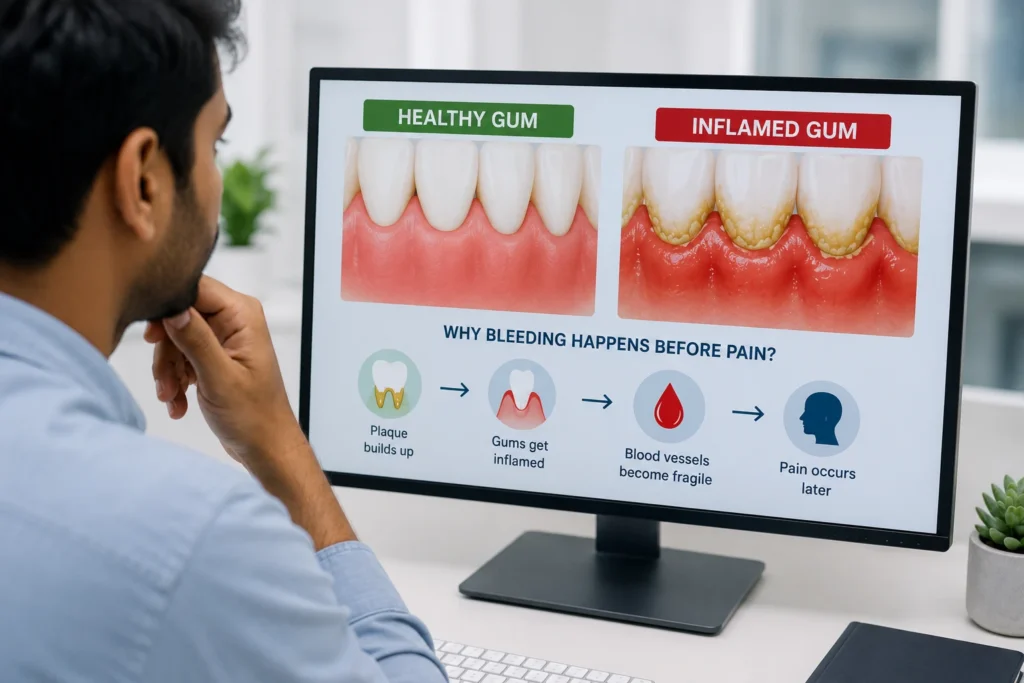
When plaque and biofilm remain around the gumline, bacteria trigger an inflammatory response. Early gum disease, known as gingivitis, may cause:
- Bleeding during brushing
- Red or swollen gums
- Tenderness around the gumline
- An unpleasant taste
- Recurring bad breath
If the condition progresses, deeper spaces known as periodontal pockets can develop between the gums and teeth.
These areas are difficult to clean at home. Bacteria and debris may collect inside them, contributing to persistent odour and gradually affecting the tissues supporting the teeth.
Advanced gum disease can eventually contribute to gum recession, bone loss, loose teeth, and tooth loss. It may progress with surprisingly little pain, which is why bad breath should not be dismissed simply because nothing hurts.
“But I Brush Twice a Day.”
That is an excellent habit.
But brushing twice a day does not automatically mean every area is being cleaned effectively.
Plaque can remain:
- Between tightly positioned teeth
- Behind the last molars
- Beneath the gumline
- Around crooked or overlapping teeth
- Around fixed dental appliances
- In areas that are rushed or repeatedly missed
Plaque that remains undisturbed can harden into tartar.
Once tartar has formed, it cannot be removed by brushing harder. It requires professional dental cleaning.
Brushing is the foundation of daily oral care. Professional evaluation helps identify what home care may be missing.
Can Dry Mouth Cause Bad Breath?
Yes.
Saliva helps wash away food particles, balance acids, and control bacterial activity. When saliva production decreases, the mouth loses part of its natural cleaning system.
Dry mouth may occur because of:
- Dehydration
- Mouth breathing
- Certain medications
- Smoking or tobacco use
- Stress and anxiety
- Some medical conditions
- Reduced saliva production during sleep
You may notice a sticky feeling, difficulty swallowing dry foods, cracked lips, a burning sensation, or a constant need to sip water.
Persistent dry mouth deserves attention because it may increase the risk of bad breath, cavities, and gum problems. The American Dental Association also identifies gum disease, tooth decay, and dry mouth among the oral factors that can contribute to halitosis.
Why Mouthwash May Not Be Enough
Mouthwash can be useful as part of an appropriate oral hygiene routine.
But it has limitations.
It cannot:
- Remove hardened tartar
- Clean deep periodontal pockets
- Repair a cavity
- Treat an infected tooth
- Correct poorly fitting dental work
- Diagnose the reason for dry mouth
- Replace professional gum treatment
Some strongly flavoured rinses can create a temporary feeling of freshness without resolving the source of the odour.
Think of it like spraying perfume in a room without taking out the rubbish.
The smell may change for a while.
The cause is still there.
Other Dental Causes That Should Be Checked
Bad breath is not always caused by gum disease. A dental examination may also identify:
- Untreated tooth decay
- Food trapped between teeth
- An infected or damaged tooth
- Partially erupted wisdom teeth
- Poorly fitting crowns, bridges, or dentures
- Difficult-to-clean dental appliances
- Inadequate cleaning around implants
- Persistent oral infections
This is why the correct treatment depends on the diagnosis.
There is no single “bad breath treatment” that works for everyone.
How a Dentist Evaluates Persistent Bad Breath
The appointment is not simply about confirming that an odour exists.
The goal is to find out why it keeps returning.
Your dentist may examine:
- Plaque and tartar accumulation
- The condition of your gums
- Bleeding points
- Periodontal pocket depth
- Areas of gum recession
- Cavities or damaged restorations
- The tongue and other oral tissues
- Saliva levels and signs of dry mouth
- Crowns, bridges, dentures, braces, or implants
Treatment may involve professional biofilm and tartar removal, gum treatment, restoration of a damaged tooth, oral hygiene guidance, or further medical evaluation when the cause does not appear to be dental.
At Chandana’s Dental Clinic, suitable patients may be offered Guided Biofilm Therapy as part of preventive or periodontal care. GBT uses a systematic process to identify and remove dental biofilm with minimally invasive technology.
Common Myths About Bad Breath
Myth 1: Bad breath always comes from the stomach
Persistent bad breath commonly originates in the mouth, although non-dental causes are possible.
Myth 2: Stronger mouthwash gives better results
A stronger taste does not necessarily mean the underlying cause has been treated.
Myth 3: If I cannot smell it, I do not have it
People can become accustomed to their own breath and may not recognise a persistent odour.
Myth 4: Brushing harder will remove the problem
Aggressive brushing can irritate the gums. It still cannot remove tartar or clean deep periodontal areas.
Myth 5: Chewing gum is a permanent solution
Sugar-free gum may temporarily support saliva flow and freshness, but it cannot treat gum disease, tooth decay, or infection.
What Can You Do at Home?
Good daily habits remain important.
You can:
- Brush twice daily using fluoride toothpaste
- Clean between the teeth every day
- Gently clean your tongue
- Drink sufficient water
- Clean dentures and removable appliances properly
- Avoid smoking and tobacco
- Replace your toothbrush regularly
- Attend dental check-ups as advised
Avoid trying to hide persistent symptoms indefinitely with mints, sprays, or repeated mouthwash use.
Freshness should come from a healthy mouth—not only from flavouring.
When Should You Visit a Dentist?
Consider arranging an evaluation if bad breath:
- Continues for several weeks
- Returns quickly after brushing
- Occurs with bleeding or swollen gums
- Is accompanied by a bad taste or discharge
- Appears with tooth sensitivity or pain
- Develops alongside dry mouth
- Occurs around a crown, bridge, denture, or implant
- Is affecting your confidence or social interactions
Bad breath is common, but persistent bad breath deserves a proper explanation.
Practical Takeaways
✔ Occasional morning breath is different from persistent bad breath.
✔ Many recurring cases begin inside the mouth.
✔ Plaque, biofilm, tartar, gum disease, decay, and dry mouth can all contribute.
✔ Mints and mouthwash may hide odour without treating its cause.
✔ Professional examination is important when the problem keeps returning.
✔ Treating the underlying condition is more effective than repeatedly covering the symptom.
Conclusion
Bad breath can feel like a social problem.
But it may actually be an oral-health message.
There is no reason to feel embarrassed about discussing it with your dentist. Dental professionals evaluate these concerns regularly, and the conversation is focused on finding a cause—not judging the patient.
If freshness disappears minutes after the mint does, your mouth may need more than another mint.
A professional dental and periodontal evaluation can help determine whether plaque, gum inflammation, dry mouth, decay, or another condition is contributing to the problem.
For patients in Kompally, Suchitra, Petbasheerabad, Jeedimetla, Alwal, Medchal, Bowenpally, Kandlakoya, and nearby areas of North Hyderabad, Chandana’s Dental Clinic provides specialist-led gum care, preventive dentistry, and personalised oral-health evaluation.
FAQs
Why does my breath smell even after brushing?
Bacteria may remain on the tongue, between the teeth, around the gumline, or beneath inflamed gums. Tooth decay, tartar, dry mouth, and infection may also contribute.
Can gum disease cause bad breath?
Yes. Bacterial accumulation and inflammation around the gums can cause a persistent unpleasant smell or taste.
Will professional teeth cleaning remove bad breath?
It may help when plaque, biofilm, or tartar is contributing to the problem. The dentist must first determine the underlying cause.
Does tongue cleaning help?
Tongue cleaning can reduce bacterial coating and food debris. It should be performed gently and used as part of a complete oral hygiene routine.
Can dry mouth make my breath smell?
Yes. Reduced saliva allows bacteria and food debris to remain in the mouth for longer.
Is mouthwash enough to treat bad breath?
Not always. Mouthwash cannot remove tartar or treat cavities, gum disease, or dental infections.
Is bad breath always a dental problem?
No. Some cases may have non-dental causes. A dental evaluation is a useful starting point because many common causes are located inside the mouth.
Which dentist should I consult for bad breath associated with gum problems?
A general dentist can perform an initial assessment. When periodontal disease is involved, care from a periodontist—a specialist in gums and the supporting structures of teeth—may be appropriate.